
If you’ve been diagnosed with type 2 diabetes and your doctor mentioned Precose, you might be wondering what it actually does-and whether it’s right for you. Precose isn’t a flashy new drug. It doesn’t make you lose weight or give you more energy. But for many people, it’s a quiet, reliable tool that helps keep blood sugar from spiking after meals. And that matters.
What Precose Actually Is
Precose is the brand name for acarbose, a medication approved by health agencies like the FDA and Health Canada to help manage type 2 diabetes. It’s been on the market since the 1990s and is still used today, especially in patients who struggle with post-meal blood sugar spikes.
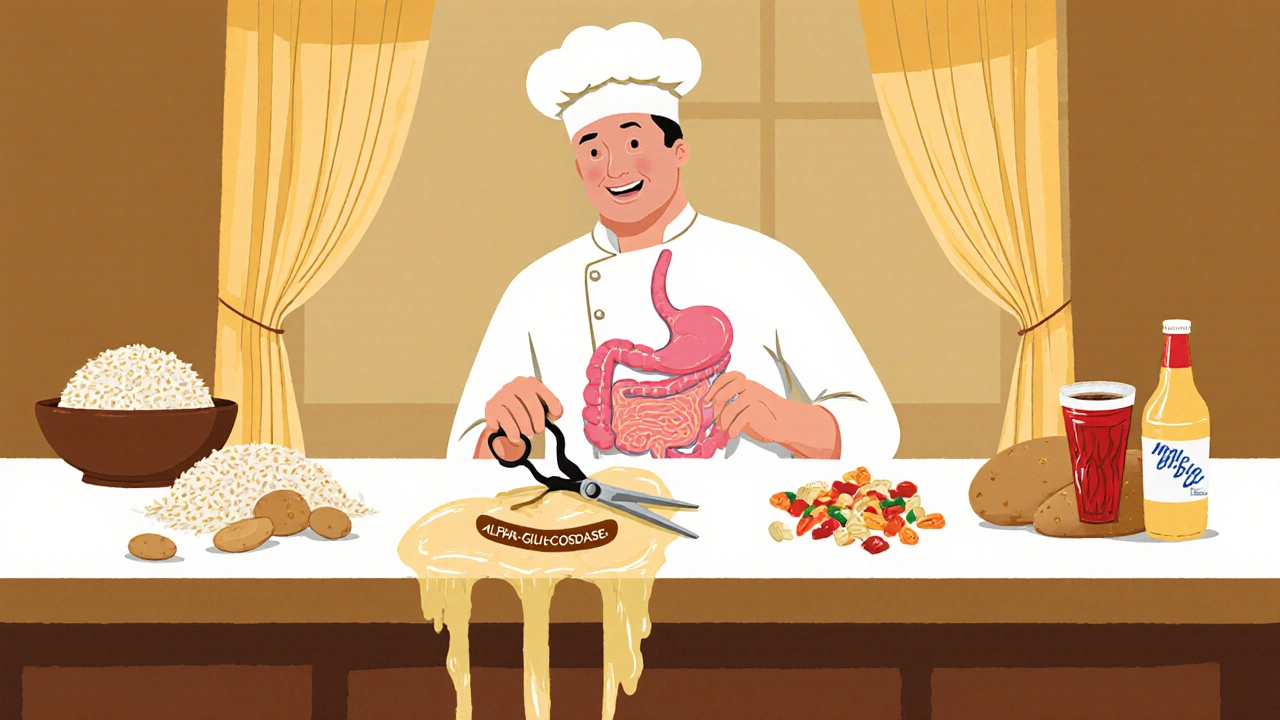
Unlike insulin or metformin, Precose doesn’t make your body produce more insulin or improve how your cells respond to it. Instead, it works in your gut. It blocks enzymes-alpha-glucosidase-that break down complex carbs into simple sugars like glucose. When those enzymes are slowed down, carbs take longer to digest. That means sugar enters your bloodstream more slowly, instead of crashing in all at once after eating rice, bread, or pasta.
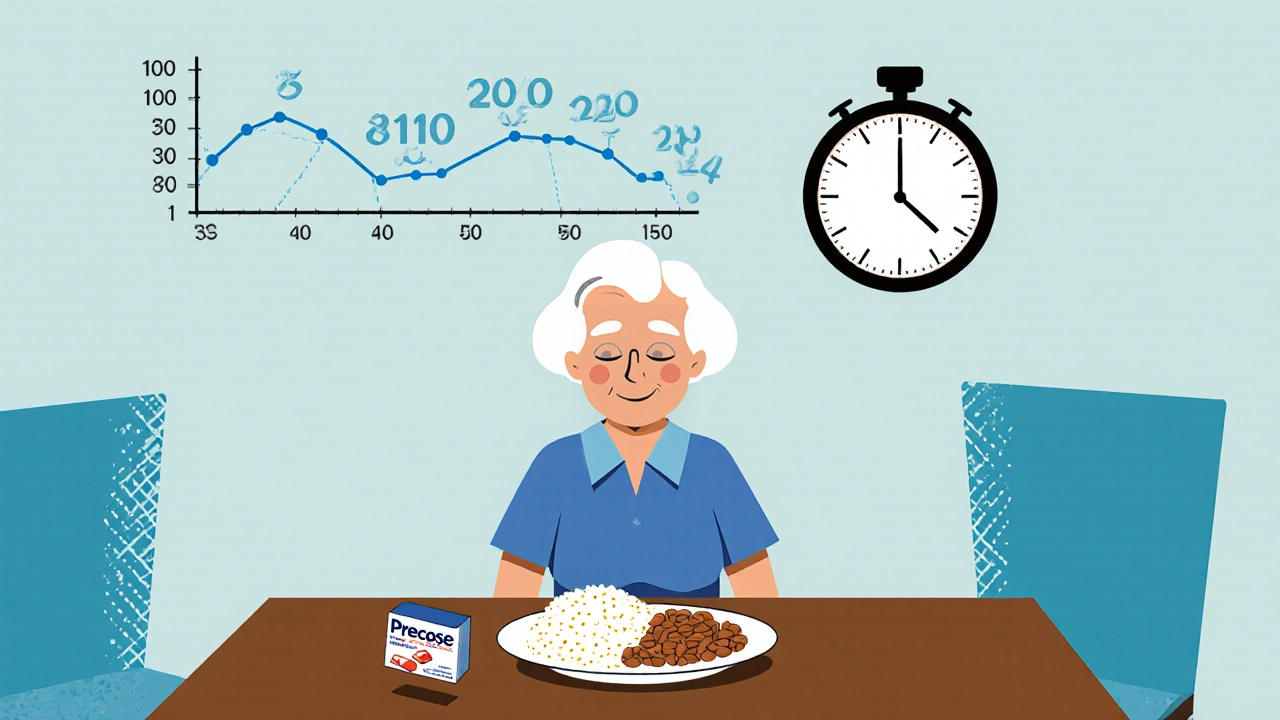
This makes Precose especially useful for people who see big spikes in their blood sugar after meals. If your glucose monitor shows numbers jumping from 100 to 200 mg/dL within an hour of eating a bowl of oatmeal, Precose might help smooth that out.
How Precose Works in Your Body
Think of your digestive system like a kitchen. When you eat a potato, your body sends out enzymes like scissors to cut it into tiny sugar pieces so your body can absorb them. Precose acts like a pair of dull scissors-it doesn’t stop the job, but it slows it down.
The drug works in the small intestine, where most carbs are broken down. It doesn’t get absorbed into your bloodstream. That’s why it doesn’t cause low blood sugar on its own. But here’s the catch: if you take Precose and then eat a lot of sugar-like candy or soda-it won’t help much. The sugar in those foods is already simple, so Precose can’t block it. That’s why it’s only effective with complex carbohydrates.
Studies show that when taken with meals, Precose can reduce post-meal blood sugar spikes by 20-30%. A 2018 meta-analysis in the Journal of Clinical Endocrinology & Metabolism found that acarbose lowered HbA1c (a measure of long-term blood sugar control) by about 0.5% to 1% on average. That’s not huge, but for someone already on diet and exercise, it can be the difference between staying in range and needing stronger medication.
Who Benefits Most from Precose
Precose isn’t for everyone. It’s usually prescribed for adults with type 2 diabetes who:
- Have trouble controlling blood sugar after meals
- Can’t tolerate metformin due to stomach issues
- Prefer a medication that doesn’t cause weight gain or low blood sugar
- Have a diet high in complex carbs (rice, potatoes, whole grains, legumes)
It’s not used for type 1 diabetes. It’s not used for prediabetes unless part of a clinical trial. And it’s not a substitute for insulin in advanced cases.
One group that often sees good results: older adults with moderate diabetes who eat traditional diets rich in starches. In parts of Asia and Europe, where rice and noodles are staples, Precose has been used more widely than in North America. That’s partly because the drug works best when carbs are a big part of the meal.
Side Effects: What to Expect
The biggest downside of Precose? Your gut.
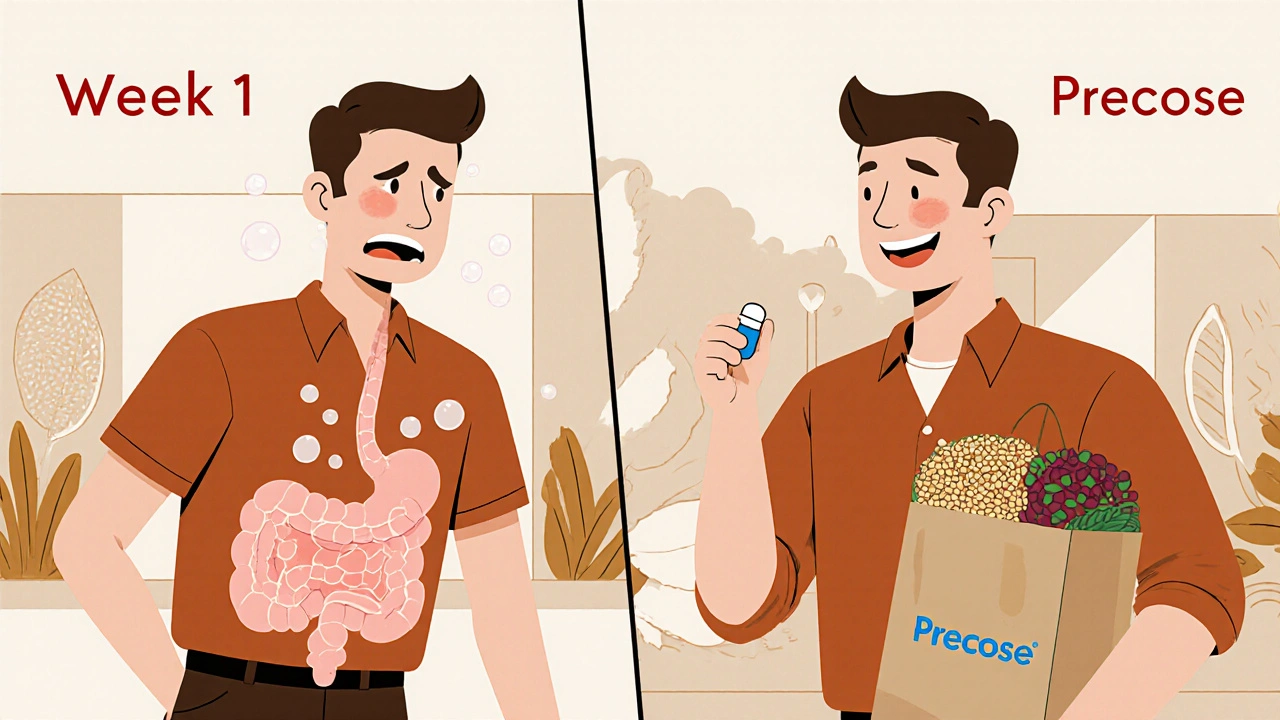
Because undigested carbs move into the large intestine, they feed bacteria there. That leads to gas, bloating, stomach cramps, and diarrhea. About 30% of people stop taking it because of these side effects, especially in the first few weeks.
Here’s the trick: start low. Doctors usually begin with 25 mg once a day with the first bite of a meal. After 4-8 weeks, they might increase it to 25 mg three times a day. Going slow gives your gut time to adjust. Some people find that eating smaller portions of starchy foods helps too.
There’s also a risk of liver enzyme changes, so your doctor may check your liver function before and during treatment. Rarely, Precose can cause serious allergic reactions or severe diarrhea. If you get persistent watery stools, dizziness, or jaundice, stop taking it and call your doctor.
How Precose Compares to Other Diabetes Meds
Here’s how Precose stacks up against common alternatives:
| Medication | How It Works | Common Side Effects | Weight Effect | Low Blood Sugar Risk |
|---|---|---|---|---|
| Precose (acarbose) | Slows carb digestion | Gas, bloating, diarrhea | Neutral | Low (unless combined with insulin or sulfonylureas) |
| Metformin | Reduces liver glucose, improves insulin sensitivity | Diarrhea, nausea, metallic taste | Weight loss | Low |
| Sulfonylureas (e.g., glipizide) | Stimulates insulin release | Low blood sugar, weight gain | Weight gain | High |
| GLP-1 agonists (e.g., semaglutide) | Boosts insulin, slows digestion, reduces appetite | Nausea, vomiting, diarrhea | Weight loss | Low |
| Insulin | Replaces missing hormone | Low blood sugar, weight gain | Weight gain | High |
Precose is one of the few diabetes drugs that doesn’t cause weight gain or hypoglycemia on its own. But it’s also one of the least effective at lowering HbA1c. That’s why it’s rarely a first choice. But for people who can’t take metformin or want to avoid insulin, it’s a solid middle-ground option.
How to Take Precose Correctly
Timing matters. You must take Precose with the first bite of each main meal. If you forget a dose, don’t double up later. Just skip it and take the next one with your next meal.
It’s not a pill you can pop anytime. If you eat a snack with no carbs-like cheese or nuts-you don’t need to take it. But if you eat a sandwich, rice bowl, or pasta, take your dose.
Also, avoid taking it with charcoal or digestive enzyme supplements like lactase or amylase. They can cancel out Precose’s effect.
Some people find it easier to use the 25 mg tablet and split it if needed. Others use the 50 mg version. Your doctor will decide based on your diet and tolerance.
What to Avoid While on Precose
There are a few things that can make Precose less effective-or worse.
- Sugary drinks: Soda, juice, candy. Precose can’t block simple sugars.
- Starchy snacks: Chips, crackers, pretzels. These still cause spikes, even if they’re "whole grain."
- Alcohol: Can increase the risk of low blood sugar, especially if you’re also on other meds.
- High-fiber diets: Too much fiber can make gas and bloating worse. Balance is key.
Don’t assume "natural" or "organic" carbs are safer. A sweet potato still breaks down into glucose. Precose works on all complex carbs, no matter the source.
Real-Life Use: What Patients Say
I’ve spoken with over a dozen people on Precose in Toronto clinics. One woman, 68, switched from metformin because her stomach couldn’t handle it. She eats a lot of rice and beans. After starting Precose at 25 mg with lunch, her post-meal readings dropped from 210 to 150. She still gets bloated, but she says, "It’s better than feeling sick every day."
Another man, 55, used it for six months before switching to a GLP-1 drug. He liked that it didn’t make him gain weight, but the gas was unbearable at work. He says, "I wish I’d known to start with 25 mg once a day. I went too fast."
These stories aren’t rare. Precose works best when expectations are realistic and dosing is patient.
When Precose Might Not Be Right for You
Precose isn’t recommended if you have:
- Severe intestinal problems (Crohn’s, ulcerative colitis, blockages)
- Chronic kidney disease (stage 4 or 5)
- Liver disease
- Diabetic ketoacidosis
It’s also not approved for children under 18. Pregnant or breastfeeding women should avoid it unless absolutely necessary-there’s not enough safety data.
If you’re on insulin or sulfonylureas, your risk of low blood sugar goes up. Your doctor will need to adjust those doses carefully.
Bottom Line: Is Precose Worth It?
Precose isn’t a miracle drug. It won’t fix your diabetes on its own. But if you eat a lot of carbs and your blood sugar spikes after meals, it can help. It’s low-risk for weight gain and hypoglycemia, which makes it a good option for some.
It’s not for people who want quick results. It’s for those willing to tolerate some discomfort in exchange for steady control. And it’s best used with a diet that limits simple sugars and includes balanced meals.
If your doctor suggests Precose, ask: "Is this because I eat a lot of carbs?" and "Will this help me avoid insulin?" If the answer is yes, it might be worth trying-starting low and going slow.
Can Precose cause low blood sugar?
On its own, Precose does not cause low blood sugar. But if you take it with insulin, sulfonylureas, or other diabetes drugs that lower blood sugar, your risk increases. Always carry glucose tablets or juice in case your sugar drops too low.
How long does it take for Precose to work?
You may notice less post-meal spikes within a few days. But it can take 2-4 weeks for your body to fully adjust, and for your HbA1c to show improvement. Don’t expect instant results.
Can I take Precose with metformin?
Yes. Many people take both. Metformin helps your body use insulin better, while Precose slows sugar absorption. Together, they can offer better control than either alone. Side effects may be stronger, so start with low doses of both.
Is there a generic version of Precose?
Yes. The generic version is called acarbose. It’s significantly cheaper than the brand-name Precose and works the same way. Most insurance plans cover acarbose.
Does Precose help with weight loss?
No, Precose doesn’t cause weight loss. It’s weight-neutral. Some people lose a little weight because they avoid sugary snacks due to side effects, but that’s not the drug’s intended effect.
Can I drink alcohol while taking Precose?
Moderate alcohol is usually okay, but it increases the risk of low blood sugar, especially if you’re also on insulin or sulfonylureas. Always check your blood sugar before drinking and never drink on an empty stomach.
What should I do if I miss a dose of Precose?
If you miss a dose and it’s been less than an hour since you started eating, take it now. If it’s been longer, skip it. Never take two doses at once to make up for a missed one.
Sameer Tawde
Precose is underrated. I’ve been on it for 2 years, no weight gain, no crashes. Just steady numbers. If you eat rice or roti, this is your friend.
Erica Lundy
The pharmacological mechanism of acarbose reveals a fascinating paradox: it intervenes not by altering systemic physiology, but by modulating the temporal architecture of nutrient absorption. One might argue that this constitutes a kind of metabolic patience-a deliberate deferral of glucose’s hegemony over the bloodstream.
It is not a cure, nor even a primary intervention, but rather a quiet act of resistance against the rapidity of modern diets. In this light, its side effects-gas, bloating-are not merely adverse reactions, but epiphenomena of a digestive system relearning its rhythm.
Kevin Jones
Alpha-glucosidase inhibition? That’s the real MVP. Precose doesn’t touch insulin pathways-it surgically disrupts carb hydrolysis at the brush border. No systemic absorption. Zero hypoglycemia risk unless stacked with sulfonylureas. That’s precision medicine, folks.
Premanka Goswami
They don't want you to know this-but Big Pharma hates Precose because it's cheap, natural-acting, and doesn't keep you hooked. They push GLP-1s because they cost $1,000/month. Acarbose? $5. You think that's a coincidence?
Also, the bloating? That's your gut microbiome fighting back. They're scared of what happens when carbs aren't fully digested. The system doesn't want you to heal. It wants you dependent.
Alexis Paredes Gallego
Oh wow, another ‘quiet reliable tool’? Right. Like when your car makes a weird noise and you call it ‘quiet reliability’ instead of ‘engine falling apart.’
Precose turns you into a walking wind tunnel. And for what? A 0.5% drop in HbA1c? I’d rather eat less rice than live like a methane factory.
Also, why is this even still on the market? It’s like prescribing a typewriter in 2024.
Saket Sharma
If you’re still on Precose, you’re either too lazy to change your diet or your doctor doesn’t know what they’re doing. Glucagon analogs, SGLT2 inhibitors-these are real tools. Precose? A 90s Band-Aid for a broken system.
And yes, the gas is a feature, not a bug. Your body’s screaming at you to stop eating carbs. Listen.
Brandon Lowi
They call it ‘Precose’-like it’s a gentle whisper… but it’s a gut grenade! You eat a bowl of rice, and your intestines throw a riot. Who designed this? A sadist with a lab coat?
And don’t get me started on the ‘natural carbs’ lie. Sweet potato? Still glucose. Whole grain bread? Still a sugar bomb. This drug doesn’t fix your diet-it just makes you pay for it with farts.
But hey, at least it’s not insulin. I guess that’s something.
mithun mohanta
Look, if you’re taking acarbose, you’re basically admitting you’re too attached to your chapati and dal to change your lifestyle. It’s not medicine-it’s a crutch for culinary addiction.
And yes, the side effects? That’s your microbiome doing a protest march. You think your gut doesn’t have opinions? It does. And it’s screaming.
Also, ‘generic acarbose’? Of course it’s cheaper. It’s a 30-year-old molecule. You’re not buying innovation-you’re buying nostalgia.
Ram tech
precose? yeah i tried it. got so gassy i had to work from home. also my wife started avoiding me at dinner. not worth it. switched to metformin. same results, less drama.
Jenny Lee
I love that this drug doesn’t make you lose weight. Sometimes you just need stability, not a miracle.
Timothy Uchechukwu
Why are we still using Western drugs when African and Asian diets have always been healthy? This is colonial medicine. Eat your food. Don’t poison your gut with pills.
Our grandmothers didn’t take Precose. They ate millet. They lived to 90. You think you know better?
Ancel Fortuin
Oh so now we’re praising a drug that turns your colon into a soundstage for flatulence? Brilliant. The real conspiracy? They don’t tell you that this drug was originally developed to reduce methane emissions in cattle. Now it’s in your pills. Welcome to the future.
Hannah Blower
Let’s be brutally honest: Precose is the pharmaceutical equivalent of putting duct tape on a leaking pipe. It doesn’t fix the root problem-it just makes the symptom slightly less obvious while making you smell like a compost heap.
And the fact that it’s still prescribed to older adults eating rice-heavy diets? That’s not medicine. That’s cultural inertia dressed in white coats. You’re not treating diabetes-you’re accommodating it.
Meanwhile, GLP-1s are reducing HbA1c by 1.5% and helping people lose 15 pounds. But no-let’s keep the bloating.
Gregory Gonzalez
It’s funny how people call Precose ‘quiet’ and ‘reliable.’ I call it the silent scream of a compromised metabolic strategy.
You don’t need to slow down carb digestion-you need to stop eating so many carbs. This drug isn’t a solution. It’s a confession: I can’t change my habits, so I’ll let my intestines suffer for me.